BUYING A HOME IN THE NORTH WEST (2025 GUIDE)
If you're relocating from London or the South East and want a four-bed with good catchments under £450k, Chester (Hoole, Upton, Handbridge) is the sweet spot; if you need sub-£200k entry prices or landlord yields, look toward Liverpool/Manchester.


George Nicola
Editor & Relocation Strategist
Analyzes Chester property markets and designs tools to match your budget with the right neighbourhood.

Nikolette Nolte
Writer - Neighbourhoods & Onboarding
Researches Chester neighbourhoods and property features to help you find your perfect home.
Can't Visit Chester In Person?
We'll attend property viewings on your behalf with professional video tours, detailed reports, and honest assessments from £39.
Book a Viewing For Me →HOW CHESTER COMPARES ACROSS THE NORTH WEST?
Chester sits at £237/sqft-midway between Manchester (£237-250/sqft) and premium Cheshire East (£280-300+/sqft). Premium Chester areas like Hoole and Handbridge run ~£299-£380/sqft, offering catchment access and period character at prices 40-50% below comparable London suburbs. The North West average is £217k (+4.5% annual growth), £56k below the UK average (Aug 2025). Liverpool offers strong value at £162-239/sqft (7.7% rental yields in L4). Cheshire East leads growth at +7.8%. First-time buyers benefit from 0% stamp duty up to £300k.
For relocators from London or the South East, Chester delivers heritage character, excellent schools, and regional connectivity at half the cost of comparable southern properties. Use our UK Property Purchase Calculator below → to estimate your total Chester buying costs including SDLT, fees, and deposit requirements.
Average North West price
Annual growth rate
Below UK average
WHY IS THE NORTH WEST MORE AFFORDABLE?
Traditional industries and slower economic transitions have kept North West property prices lower than in the South, where faster wage growth and stronger links to finance, tech, and global business hubs have driven sharp increases.
The North West's average house price now sits around £217,000 (ONS, Aug 2025), while Cheshire West & Chester averages £266,000 (+5.5% YoY), still well below the South East and London where prices frequently exceed £400,000.
While demand is strong in Manchester, Liverpool, and Cheshire, the region has faced less upward pressure from international buyers and luxury-led development, helping to moderate price rises and preserve more accessible entry points.
Projects such as the Liverpool-Manchester New Railway, Transpennine Route Upgrade, and Mottram Bypass boost regional connectivity, while the Rectory Lane 200 MW Energy Storage System and Peel Road Battery Storage strengthen energy capacity. Regeneration at Phoenix Works, Barrow, Ellesmere Port, and Manchester districts, plus hospital and school upgrades, sustain demand.
For local buyers, higher wages, lower mortgage rates, and more flexible lending have improved affordability, but the cost-of-living and property price escalation have been far less intense than in London and the South East.
Migrating buyers from these more expensive regions or overseas often find they can secure larger homes, stronger amenities, and comparable lifestyles for substantially lower outlays - sustaining demand while keeping the North West relatively good value. At the same time, ongoing regeneration, new transport links, and city-centre investment are reinforcing market strength without pushing prices to the levels seen in southern hotspots.
HOW MUCH MORE AFFORDABLE IS THE NORTH WEST?
As recorded by the UK House Price Index (August 2025, HM Land Registry/ONS), the average UK house price stands at £273,000. The North West average is £217,000, about 21% below the UK average, meaning buyers secure more space and amenities for less.
By contrast, London's average of £561,000 is roughly 93% higher than the UK average, while the South East at £383,000 sits 32% above. London, compared to the North West, is around 2.6 times more expensive, which is 163% above the North West average. In other words, properties in the North West are nearly 62% more affordable compared to London.
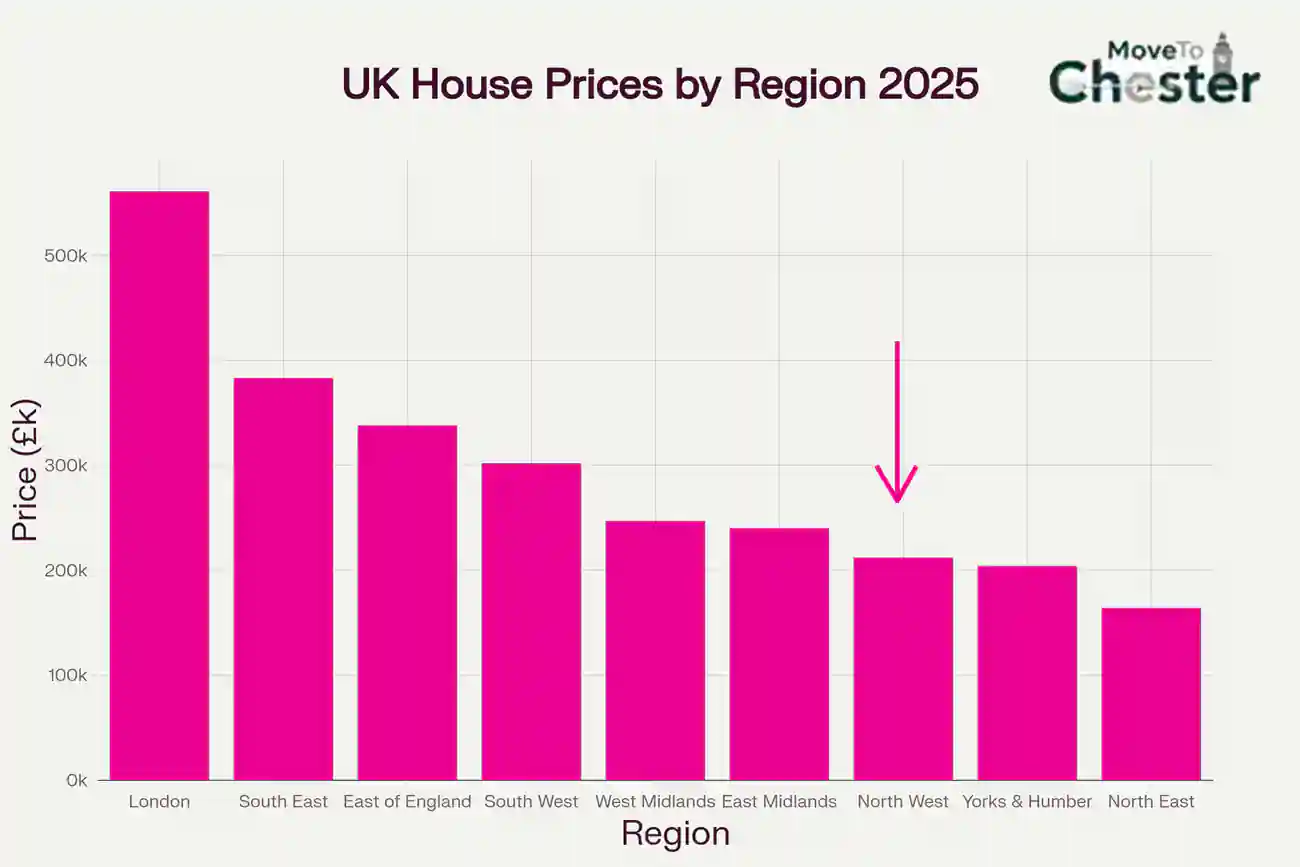
Other northern regions also show affordability, with the North East at £164,000 (44% below average) and Yorkshire & The Humber at £204,000 (30% below). Mid-tier markets such as the East Midlands (£240,000, 18% below) and the West Midlands (£247,000, 15% below) highlight a gradient of affordability compared with southern counterparts.
Premium southern markets remain elevated, with the East of England at £338,000 (16% above) and the South West at £302,000 (4% above).
This regional divide underpins buyer migration from higher-cost areas into more affordable northern markets. Chester specifically attracts families seeking £300-450k properties in areas like Hoole, Upton, and Christleton-combining top school catchments, walkable neighborhoods, and 90-minute rail access to London at prices 50-60% below equivalent South East locations. Need street-level detail? Compare Chester neighbourhoods for walkability, schools, and commute times.
- Chester average: £237/sqft-midway between Manchester (£237-250/sqft) and premium Cheshire East (£280-300+/sqft)
- Premium Chester areas (Hoole, Handbridge): £299-£380/sqft with top school catchments and period character
- North West average: £240/sqft (£217,000 property price, +4.5% YoY growth)
- England & Wales average: £334/sqft
- London comparison: Chester properties cost 40-50% less than equivalent South East locations with similar amenities and commute access
See how these numbers hit your monthly budget: Chester Cost of Living Guide
WHAT MAKES NORTH WEST SO IN DEMAND?
The primary driver of demand is the affordability gap compared to the rest of the country. With average home prices over £56,000 below the UK average (around 20% cheaper), the North West offers one of the widest affordability discounts outside Scotland. This creates a more accessible entry point onto the property ladder for a wide range of buyers, particularly those relocating from higher-cost regions.
The North West's overall market growth of +4.5% trails only slightly ahead of the national UK average of roughly +3.0%, demonstrating its stability and resilience. Certain areas significantly outperform this average. For example, Cheshire East is leading the way with exceptional growth of +7.8%, offering buyers the chance for significant capital appreciation.
The region is a hotspot for buy-to-let investors due to its impressive rental yields. Key postcodes in Liverpool (L4) are achieving yields of 7.7%, while areas in Manchester (M14) are reaching as high as 9.7%, promising strong and consistent returns.
The North West is especially popular with first-time buyers. The government's enhanced stamp duty relief, maintaining the £300,000 zero-tax threshold, provides a strong financial incentive that makes purchasing a first home in the region's affordable market more achievable.
HOW TO DECIDE WHERE TO BUY IN THE NORTH WEST?
To decide where to buy in the North West, match your priorities - budget, lifestyle, and investment goals - to the strengths of each key area. The region's property market is not one-size-fits-all but a collection of distinct opportunities.
The most accessible entry point is Liverpool, with prices from £162 per sq ft, stands as the region's value leader. Manchester and Chester cluster around £237 per sq ft, offering competitive city pricing. Cheshire East commands £280-£300+ per sq ft, reflecting its premium status and consistent growth.
3 STEPS TO CHOOSING THE RIGHT AREA IN CHESTER
Skip the overwhelm. Follow this proven 3-step process to find your perfect Chester neighbourhood:
What Kind of Lifestyle Do You Want?
Start by defining your ideal day-to-day experience in Chester.
City centre, cafes, no car needed
Schools, parks, quiet streets
Train access, parking, road links
Historic areas, nightlife, events
What Can You Afford?
Understanding Chester's price tiers helps you focus on realistic options.
£180-220/sqft
First-time buyers, apartments
£220-280/sqft
Family homes, professionals
£280-350/sqft
Executive properties, premium
Explore Matching Neighbourhoods
Now you're ready to explore areas that match both your lifestyle and budget.
Based on your preferences, you'll see:
- Matching neighbourhoods with photos
- Walk scores and transport links
- School catchments and ratings
- Sample property prices
BEST AFFORDABLE AND LARGEST CITY TO BUY IN THE NORTH WEST?
Liverpool stands out as the best affordable place to buy in the North West, earning its position as the region's value champion. Prices average £162-£239 per sq ft (among the lowest for a major UK city in 2025) depending on postcode (average price house: £162,000-£214,000), with L4 delivering standout rental yields of 7.7% (Property Investments UK, 2025).
The L4 area spans Anfield, Walton, and parts of Kirkdale, districts defined by affordability and ongoing regeneration. Anfield, home to Liverpool FC, is benefiting from significant investment that is reshaping its housing market; Walton offers strong residential value and transport links into the city; while Kirkdale, closer to the docks and city centre, is attracting new interest through redevelopment projects. Together, these neighbourhoods underpin L4's reputation for both rental performance and long-term growth, making Liverpool a compelling option for first-time buyers and investors alike.
Manchester is the next largest, but key affordable postcodes (M14, M9) are pockets within a city whose median prices trend higher (flats ~£237-£250/sq ft, many areas over £250k)
WHERE IN THE NORTH WEST IS IT GOOD TO BUY A HOUSE?
Chester remains one of the North West's most resilient and attractive housing markets, offering a blend of historic character, commuter convenience, and relative affordability compared to larger metropolitan centres. Average property prices currently sit between £255,000 and £257,000, reflecting a modest 2-3% rise over the past year.
At around £237 per sq ft, values remain attractive following an 11% market correction from previous highs. Detached homes average £421,000, semi-detached £254,000, terraced properties £199,000, and flats £132,000. Approximately 8,000 properties sell annually, with the majority of transactions falling in the £150k-£250k range, highlighting the market's accessibility.
Key postcode areas reflect Chester's diverse housing offer. CH1 covers the city centre, blending period homes with modern apartments. CH2 includes family-friendly suburbs such as Handbridge, known for strong schools. CH3 extends to outskirts like Huntington and Upton, offering more affordable family housing. CH4 covers areas such as Great Boughton, prized for its community feel and green spaces.
BEST PREMIUM MARKET IN THE NORTH WEST - CHESHIRE EAST
With a population of around 400,000, Cheshire East leads the region in growth and premium housing demand. Average prices sit at approximately £292,000 as of mid-2025, with premium properties commanding £280-£300+ per sq ft. Detached family homes often exceed £400,000, reflecting strong executive and family market demand. The area has recorded the fastest year-on-year growth in the North West at +7.8%, reinforcing its reputation as the region's premium destination.
Several areas define the county's housing market. CW9 (Knutsford) offers upscale family homes and a high quality of life. SK10 (Macclesfield) combines period properties and new builds set against scenic surroundings. WA16 (Wilmslow) stands out as a prestigious hub for executives and families seeking premium homes. More affordable options are found in CW4 and CW5, where suburban and village neighbourhoods are increasingly popular with value-focused buyers.
Cheshire East delivers a balanced market where premium lifestyle, strong schools, and excellent connectivity combine with robust price growth, making it one of the North West's most desirable and resilient locations.
CHESHIRE WEST VS. CHESHIRE EAST - WHERE TO BUY?
Move to Cheshire West or Chester if you want a safe environment, modest prices, and value for money, with opportunities for first-time buyers and families in a heritage-rich area. Buy in Cheshire East if you are comfortable with higher prices and seek premium or executive homes with investment growth potential while being closer to 2nd largest city in the UK.
Cheshire West & Chester (CWC) and Cheshire East (CE) represent two distinct poles of the North West property market: CWC's historic city-centered affordability versus CE's expansive premium growth. Cheshire West & Chester is accessible, heritage-rich, and family-friendly, defined by Chester's historic core and surrounding commuter towns. In contrast, Cheshire East is affluent, aspirational, and growth-driven, anchored by executive hubs such as Wilmslow, Knutsford, and Macclesfield.
Cheshire West & Chester offers value, diversity, and character, with average prices more modest and recent corrections opening opportunities for first-time buyers and families. Cheshire East commands prestige, exclusivity, and resilience, with higher average prices and the region's strongest year-on-year growth, driven by sustained demand in the executive housing market.

Safety Comparison
Cheshire West and Chester records an overall crime rate of 70.3 per 1,000 residents, rated 3 out of 10 for safety compared to other UK boroughs. The most frequent offenses are violence and sexual offenses (31.1 per 1,000), followed by public order (8.12) and anti-social behavior (8.11), many of which occur during large event gatherings, inflating the figures.
In comparison, Cheshire East has a slightly lower overall crime rate of 64.9 per 1,000 residents, the lowest within its police force area. The total crime level for both CWC and CE remains lower than the wider England rate (87 per 1,000 population), reflecting safe environments in which to move in and establish a life.
In Cheshire West & Chester, the most common buyer profiles are families, first-time buyers, retirees, and those drawn to heritage, character, and community. In contrast, Cheshire East typically attracts affluent families, executives, investors, and buyers prioritising exclusivity, prestige, and long-term growth.
One bill. One setup. Zero stress.
Bundle energy, broadband, and mobile into a single, easy plan. Save time, avoid missed payments, and move in with everything ready.
Set up everything in one bill now →Is Liverpool within Cheshire West?
Liverpool is not within Cheshire West and Chester. It is a separate metropolitan borough and city located in Merseyside, just north of the River Mersey. Cheshire West and Chester instead covers key urban areas such as Chester, Ellesmere Port, and Northwich. The Wirral Peninsula is divided: some southern parts fall under Cheshire West and Chester, while the Metropolitan Borough of Wirral governs the majority in Merseyside.
Liverpool (Merseyside) vs Cheshire West boundaries
BUYING A PROPERTY IN THE UK PROCESS (2025 TIMELINE)
In the UK, buying a home in 2025 usually takes about six months from start to finish. First, you get a quick check from the bank, called a Mortgage Decision in Principle (usually within 24 hours), to see how much you can borrow. Then you search for a property and make an offer, which can take 4-12 weeks depending on what you're looking for.
Once your offer is accepted, you formally apply for the mortgage (up to 2 weeks) and hire a lawyer (conveyancer) to handle the legal checks and contracts. This stage also includes surveys of the property and normally lasts 6-8 weeks, but it can take longer if several people are buying and selling at the same time (known as a chain).
At the end, the contracts are exchanged and you complete the purchase, which takes another 1-4 weeks.
Overall, the process averages six months, but it can be quicker (around 4 months) or slower (up to 8 months) depending on the situation.
Unlike in the United States, France, or Spain, where buyers and sellers in typical property transactions often meet face-to-face and work closely with their lawyer or agent throughout the process, in the UK, most buyers and sellers never meet in person.
In the UK, buyers and sellers usually do not communicate directly, as estate agents and lawyers manage all negotiations and paperwork. In private sales or smaller transactions, they may occasionally speak to confirm practical details such as fixtures, boundaries, or handover arrangements.
TYPICAL PROPERTY TRANSACTION TIMELINE:
- Mortgage Decision in Principle: 24 hours (HSBC 2025 data)
- Property Search & Offer: 4-12 weeks
- Mortgage Application: Up to 2 weeks
- Conveyancing & Surveys: 6-8 weeks (can extend to 12 weeks in chains)
- Exchange to Completion: 1-4 weeks
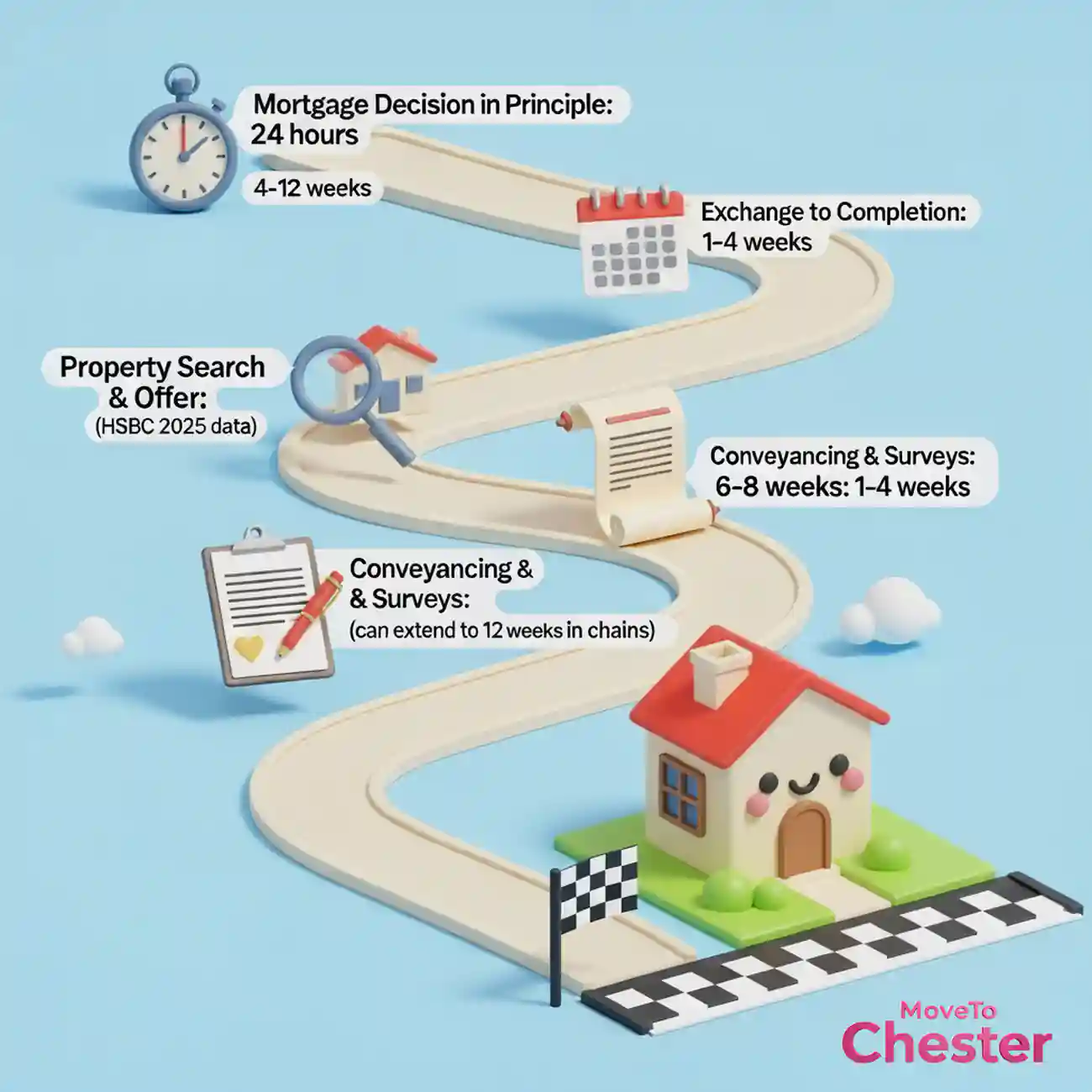
The 2025 buying process typically spans around six months on average, though depending on chains and individual circumstances, transactions can be completed in as little as four months or extend up to eight, requiring buyers to plan with flexibility.
Total Timeline: 6 months average (HSBC UK 2025), can range 4-8 months.
Who decides the closing date (called completion date in the UK)?
The buyer and seller agree together, usually after the lawyers (conveyancers) have finished all legal checks and contracts are ready. The date is proposed during the exchange of contracts stage, with both sides confirming a mutually acceptable day. If there's a chain (multiple linked transactions), the date is often influenced by the slowest party in the chain.
Can I back out of buying a house before closing?
Yes - you can, but you'll need a valid reason and you may lose part or all of your deposit.
Before exchange = you can walk away (but lose sunk costs).
After exchange = you're locked in (and backing out is very expensive).
The key points are:
| Step | What happens | What you can do |
|---|---|---|
| 1. Offer accepted | You sign a conditional offer and pay a 5-10% deposit of the purchase price. | You can still withdraw, but you risk losing the deposit. |
| 2. Conditions are met | The sale is conditional on buyer's finance approval, property survey, and any other agreed checks. | If a condition is not satisfied (e.g., mortgage denied, survey finds major defect), you can legally withdraw without penalty. |
| 3. Before exchange | Solicitors exchange signed contracts. The sale becomes legally binding. | You can still back out, but you'll usually lose the deposit. |
| 4. After exchange | Property is legally yours once settlement occurs, usually 1-2 days before transfer. | You can still back out, but you'll almost certainly lose the deposit and may pay a break-up fee (up to 1% of price). |
How is a closing date decided?
The buyer may suggest a preferred date, but it must work for the seller too. Lawyers coordinate between both sides, balancing mortgage release dates, removals, and the availability of funds. It only becomes legally binding once contracts are exchanged. The buyer usually receives the keys on the day of completion, once the seller's solicitor confirms that payment has gone through. In most cases, keys are collected directly from the estate agent's office, though in some situations they may be handed over by the seller or delivered by post. Delays beyond the completion day are very rare.
What if the seller hasn't moved out by the key handover?
If the seller hasn't moved out by the time the keys are due to be handed over on completion day, it can cause serious problems. Legally, the property should be vacant (unless otherwise agreed upon, e.g., with sitting tenants) once the funds are transferred.
The best practices point that sellers are expected to clear the property and hand over keys immediately after completion.
If the delay is caused by the seller, the buyer can refuse to move in until the property is vacated, and in some cases may claim compensation for extra costs (such as storage, hotel stays, or removals rescheduling). The worst case is when or If the seller outright refuses to leave, the buyer may need to seek legal enforcement, though this is very rare and usually resolved by solicitors quickly.
Are there costs involved?
Usually, there is no extra fee just for setting the date. The costs that go along with a transaction are legal fees, mortgage arrangement fees, removal costs, or penalty costs.
Conveyancing/legal fees cover all legal work up to completion, including property searches (checking for planning restrictions, flood risk, or local authority issues), drafting and reviewing contracts, handling Land Registry paperwork, and transferring funds.
Mortgage arrangement fees depend on the type of mortgage and lender; in some cases, there are no fees at all. For cash buyers, there are no mortgage fees, which simplifies the process and can speed up completion.
Removal costs are incurred if the buyer hires movers or vans to transport belongings on the agreed date. Penalty costs apply if one side fails to complete on the agreed date, for example, through daily interest charges or compensation payments, or if a party backs out after exchange of contracts.
In short, the closing date is mutually agreed upon by buyer and seller, coordinated by lawyers, and becomes binding at contract exchange. The costs are indirect legal, mortgage, and moving-related rather than a specific "closing date fee."
WHAT DEPOSIT IS NEEDED TO BUY A PROPERTY IN UK? (2025 RATES)
A deposit is usually at least 5% of the property price, but often around 10-20% to access better mortgage rates. For example, a 10% deposit on a £300,000 house would be £30,000, additionally, prepare £3-7,000 for additional closing costs.
WHAT TAXES AND FEES DO YOU PAY WHEN BUYING PROPERTY?
One of the largest upfront costs is the deposit, typically ranging from 5% to 25% of the property's value. Most lenders (banks or financial institutions that lend you money), often called mortgage lenders, expect at least 10-15%, so for a £300,000 house, this means setting aside around £30,000 to £45,000.
A mortgage lender offers a loan specifically for purchasing real estate, distinct from a personal loan. It typically has a long repayment term, ranging from 5 to 30 years, and comes with either a fixed or variable interest rate.
First-Time Buyers: 0% up to £300,000, 5% on portion £300k-£500k
Standard rates: 0% to £250k, 5% £250k-£925k
Stamp Duty Land Tax (SDLT) is another major expense. This is a tiered government tax based on the property's price. In England, no stamp duty is paid on the first £125,000; 2% is paid on the portion between £125,001 and £250,000; and 5% on the portion between £250,001 and £925,000. For a home priced around £300,000, the SDLT bill would be approximately £4,750. First-time buyers may qualify for relief on homes priced up to £300,000.
Legal or conveyancing fees cover the cost of transferring ownership and generally range from £850 to £1,850. Survey fees, which assess the property's condition, vary depending on the type of survey simpler valuations start at around £400, while full structural surveys may cost up to £1,500.
Other fees include land registry charges, typically between £40 and £270, and mortgage arrangement fees, which can range from £100 to £2,500 depending on the lender. Buyers should also account for moving costs, insurance premiums, and broker fees if using professional services.
These additional costs can add approximately 5-25% to the purchase price. For a £300,000 home, first-time buyers should budget an extra £6,000; if this is a second or higher tier home expect up to £12,000 on top of the deposit, largely because of the £5,000 stamp duty plus the same other fees.
| Item | Typical Cost | Notes |
|---|---|---|
| Deposit | 10% - 15% | £30,000 - £45,000 |
| Stamp Duty Land Tax (SDLT) | £0 (first-time buyer) or 2% on £125,001 - £250,000 and 5% on £250,001 - £925,000 (standard buyer) | £4,750 for a standard buyer on a £300,000 property |
| Legal / Conveyancing fees | £850 - £1,850 | Depends on solicitor's rates |
| Survey | £400 - £1,850 | £400 for a basic valuation, £1,850 for a full structural survey |
| Land Registry fee | £40 - £270 | Depends on property value |
| Mortgage arrangement fee | £100 - £2,500 | Varies by lender |
| Moving costs & insurance | £500 - £3,000 | Depends on distance and coverage |
| Broker fees (if used) | £0 - £2,500 | Optional, varies by broker |
What taxes and fees do you pay when buying property?
One of the most significant one-time taxes is the transfer tax, known in the UK as Stamp Duty Land Tax (SDLT). This tax is based on the purchase price and varies depending on factors such as whether the buyer is a first-time purchaser or if the property is a second home. While SDLT can be a substantial upfront cost, it must be paid before the purchase is completed.
In addition to SDLT, buyers should plan for a recurring property tax, typically paid annually and based on the property's assessed value. This tax varies by local authority and contributes to the long-term cost of ownership.
Several professional fees also apply during the transaction. Solicitors or licensed conveyancers charge for their legal work done during the legal conveyance stage, either as a flat fee or a percentage of the sale price. Estate agents usually receive commission from the seller but may charge buyers for specific services. Lenders apply fees for processing the mortgage, such as arrangement and valuation fees. Title services involve additional costs, including insurance to protect against future ownership disputes, including notary fees (for verifying signatures and documents), and recording fees (for officially registering the new ownership with the Land Registry).
Together, these taxes, fees, and administrative costs can total several thousand pounds, typically on a £300,000 the fees are calculated above, depending on the property's price and location. Budgeting for them is essential to avoid unexpected financial strain and to ensure a smooth transition from contract to completion.
How Property Value Is Assessed and Agreed Upon?
Another crucial aspect of the real estate purchase process is valuation and pricing, which helps establish a fair market value and forms the basis for negotiating the purchase.
Valuation involves an appraisal process where the property's worth is assessed through market comparisons, often called "comps." This means reviewing recent sales of similar properties in the area, considering factors such as size, condition, location, and amenities, and making adjustments for any differences. For example, if one property has a newly renovated kitchen and another does not, its value might be adjusted upward to reflect that feature.
Once the valuation is established, the focus shifts to price negotiations. The buyer may make an offer based on the valuation, the seller may respond with a counteroffer, and both parties work toward acceptance and a binding agreement. This phase is influenced by market conditions, the motivations of the buyer and seller, and input from brokers or agents.
This sequence appraisal, comparison, adjustment, and negotiation forms the framework that precedes detailed cost considerations. It ensures both buyer and seller understand the property's value before progressing to contract exchange, conveyancing, and closing.
How Property Purchases Are Financed: Mortgage Basics?
The next essential element in the property buying journey is financing and mortgage, which defines how the buyer can afford the purchase and outlines the terms for loan repayment.
Mortgage financing involves several key loan terms that shape the cost and structure of borrowing. At the core is the principal, the initial loan amount borrowed. Alongside this is the interest rate, the annual cost of borrowing expressed as a percentage. The mortgage term typically 20 to 30 years defines the time frame for full repayment. Amortization determines how monthly payments are divided between interest and principal. In the early years, payments primarily cover interest, with a gradual shift toward principal reduction over time.
Buyers also encounter upfront costs when securing a mortgage, including points and origination fees. Points are prepaid interest that can reduce the long-term interest rate, while lenders charge origination fees for processing the loan application.
In addition to these initial costs, ongoing expenses include interest payments, which vary depending on whether the rate is fixed or variable, and private mortgage insurance (PMI) or mortgage insurance premiums, typically required when the deposit is below a specific threshold to protect the lender from default risk.
Recognizing financing terms is essential, as they directly impact monthly affordability, total interest paid over the loan's lifespan, and flexibility for early repayments or refinancing. Brokers and agents play a key role in this phase, helping buyers compare mortgage options, negotiate favorable rates, and manage related expenses.
How to inspect a property for sale?
Inspection of a property must be carried out before you place an offer; never buy or submit an offer without physically seeing and investigating the home or without a trusted agent or service to conduct the inspection. The inspection or due diligence phase is of two types - physical and legal, where both are different from the viewing. Either can be carried at the same time
Can't Physically Visit?
Relocating from far away? Our professional viewing service attends on your behalf. We film comprehensive video tours, test everything from water pressure to heating, measure rooms, and deliver detailed condition reports with honest recommendations.
Learn About Remote Viewings →A viewing is simply a walkthrough of the property, usually the first time you see the house. You check its general look, layout, and curb appeal. An inspection is a deeper, systematic examination that follows the viewing. It involves professional assessors who test structural integrity, mechanical systems, electrical wiring, plumbing, and sometimes environmental factors.
The goal of a physical inspection is to uncover hidden defects or safety issues that a casual viewing would miss, while the legal inspection focuses on title and ownership. A standard inspection takes about 1 to 3 hours on the day of the visit, while the final written report is usually ready within 1-2 business days. If you add specialised tests, the total time can extend to 4-6 hours.
Inspection usually involves several steps, collectively called Due Diligence, which serves as the buyer's and lender's thorough review of the property's true condition and legal status.
As part of the lender (the bank) checks and inspections on the property are to verify property title, surveys, environmental reports, previous owners, easements, and rights of way, and in some cases, they will produce an engineering report, which the buyer can request, but it is wise to secure independent inspections to verify those findings.
Due diligence covers a wide range of checks and verifications.
Physical inspections typically evaluate the building's structure and overall condition, as well as the mechanical, electrical, and plumbing (MEP) systems, ensuring they function correctly. These inspections help uncover potential repairs or maintenance issues that could impact the property's value or safety.
Solicitors, surveyors, and other experts are key in guiding buyers through this process and ensuring all risks and obligations are fully understood.
Need eyes on a property before you travel?
We attend the viewing, film it, and send a same-day report so you can evaluate properties remotely with confidence.
How is property ownership legally transferred?
Legal conveyance is the critical phase where ownership of the property is formally transferred and all prior inspections, valuations, and financial agreements are finalized through legally binding documentation. Legal conveyance acts as the bridge between due diligence, financial agreements, and the final stages of the property transaction, ensuring the deal is legally sound and ready for closing and possession.
Legal conveyance begins with drafting and reviewing contracts that define the key conditions and warranties of the sale done by your solicitor (lawyer) and agents. Conditions may include requirements like repair obligations or timelines for completion, while warranties confirm the accuracy of information provided about the property. These terms ensure both parties clearly understand their responsibilities before proceeding.
Ownership is formalised through a deed or title, which is held by the buyer's solicitor or conveyancer during the transaction. They handle document preparation, ensure legal compliance, and protect both parties' interests, providing clarity and security at every step. Once the conditions are met, the deed is recorded with the Land Registry, making the ownership transfer legally recognised.
How much does it cost to maintain a home in the UK?
Ownership of UK property brings ongoing financial commitments beyond the initial purchase, commonly referred to as ownership carrying costs. These expenses are crucial for maintaining a sustainable homeownership experience, as they affect both monthly and annual budgets well after completion.
A key recurring expense is insurance, which protects against risks such as fire, flood, or structural damage. Annual home insurance premiums typically range from a few hundred to several hundred pounds, depending on property size, location, and coverage level. For leasehold properties or homes in managed estates, service charges may also apply. These charges fund communal maintenance, repairs, and sometimes amenities or security, with costs varying widely depending on the property type.
Freehold gives you full ownership and control, with no ground rent.
Leasehold gives you the right to live in the property for a set period, but you'll pay ground rent, service charges, and may need permission for changes.
Maintenance planning is another vital aspect. Operational expenditures (OpEx) include routine upkeep such as boiler servicing, gardening, and minor repairs. In addition, homeowners are advised to set aside funds for capital expenditures (CapEx) larger, less frequent projects like roof replacements or structural upgrades to ensure financial readiness for major repairs over the property's lifespan.
Alongside maintenance, homeowners must also arrange utilities, which form a significant part of ongoing monthly costs. There are two main ways to set them up:
Best if: you want one account and fewer payments.
Trade-offs: less flexibility to cherry-pick tariffs or features.
What you'll need: property address/postcode, move-in date, and opening meter readings.
See bundle steps →Best if: you prefer to compare and choose each service separately.
Trade-offs: more accounts to manage and extra admin.
What you'll need: the same documents as above, plus time to compare offers.
If you want to simplify bills and potentially save money, consider our affiliate Utility Warehouse, which offers bundled utility services to streamline payments and reduce costs.
Set Up Bundle Services →KEY FAQS & RESOURCES
What are the stamp duty rules for Chester properties?
Stamp duty rates for Chester properties follow standard UK rates: 0% on the first £250,000, 5% on £250,001-£925,000. First-time buyers get relief up to £425,000 property value. Most Chester homes fall within favourable stamp duty brackets.
Is Chester a good investment location?
Chester offers strong investment potential with steady 4-6% annual growth in premium areas, strong rental demand from professionals and students, and significant value compared to London/South East. The city's employment base and transport links support long-term demand.
How long does it take to buy a house in Chester?
Typical timeframe is 8-12 weeks from offer acceptance to completion. This includes mortgage approval (2-4 weeks), surveys (1-2 weeks), and legal work (4-6 weeks). Chain-free purchases or cash buyers can complete faster.
What do foreign buyers need to know?
Foreign buyers face additional 2% stamp duty surcharge but can access UK mortgages with higher deposits (25-40%). Chester's international community, particularly in Westminster Park and Hoole, provides good support networks. Legal representation is essential for overseas buyers.
CHESTER'S UNIQUE LIVING EXPERIENCE
Chester combines historic charm with modern practicality, offering buyers exceptional value compared to major metropolitan areas. The city's diverse neighbourhoods ensure options for every lifestyle and budget, from first-time buyers to luxury seekers.
With steady market growth, excellent transport links, and a thriving community, Chester represents both a lifestyle upgrade and sound investment. The key to success lies in matching your neighbourhood choice to your specific needs - whether that's school catchments, commute requirements, or community character. Prioritizing schools? See Chester Schools & Education for catchment maps, Ofsted ratings, and admissions timelines.
Simplify your utilities setup, explore neighbourhoods, or shortlist homes remotely - everything you need for a smooth Chester move.